
Ankle injuries are among the most common reasons people seek foot and ankle care. From a simple misstep on uneven ground to a sports-related collision or a fall at home, ankle sprains and fractures can happen suddenly and disrupt everyday life. With this in mind, finding expert care for ankle sprains and fractures in Canton, Ga often begins with understanding the differences between sprains, strains, and fractures, along with knowing when professional care may be necessary. For patients searching for a sprained ankle specialist in Canton, expert evaluation plays a key role in accurate diagnosis, effective treatment, and long-term joint stability.
Ankle pain can range from mild soreness to significant swelling and bruising. However, some injuries improve with rest, whereas others require medical evaluation, imaging, and structured treatment to heal properly and prevent long-term complications.
Table of Contents
Understanding Sprains, Strains, and Fractures
 Although the terms are sometimes used interchangeably, sprains, strains, and fractures are very different injuries. provide a transition word for this sentence
- Ankle sprains involve stretched or torn ligaments that support the ankle joint.
- Strains affect muscles or tendons.
- Fractures refer to a break in one or more bones of the ankle or foot.
Knowing the difference between sprains, strains, and fractures matters because each injury heals differently and requires appropriate care. Overlooking a fracture or assuming a severe sprain will resolve on its own can lead to lingering pain, weakness, or joint instability.
Types of Ankle Sprains Treated by a Canton, GA Specialist
There are several types of ankle sprains, each varying in severity:
- Grade I sprains involve mild ligament stretching with minimal swelling.
- Grade II sprains include partial ligament tears, moderate swelling, and difficulty bearing weight.
- Grade III sprains are complete ligament tears, often causing significant swelling, bruising, and joint instability.
Patients frequently ask how long ankle sprains last. Mild sprains may improve in one to two weeks, while more severe ankle sprains can take six to twelve weeks—or longer—depending on ligament damage and adherence to treatment.
Types of Ankle Fractures and Foot Fractures
Unlike sprains, fractures involve bone damage. Common ankle fractures include:
- Lateral malleolus fractures (outer ankle bone)
- Medial malleolus fractures (inner ankle bone)
- Bimalleolar or trimalleolar fractures involving multiple bones
Foot fractures, including metatarsal and toe fractures, are also common after falls or impact injuries.
Another frequently overlooked condition is stress fractures, which develop gradually from repetitive stress rather than a single traumatic event. These injuries are common in runners, athletes, and individuals who suddenly increase activity levels.
How Imaging Helps Identify Ankle Injuries
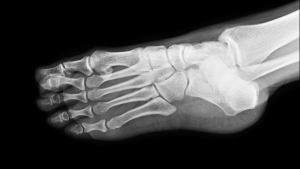
When ankle pain, swelling, or bruising persists, imaging is often necessary. X-rays help determine whether a bone is cracked, displaced, or fully broken and play a key role in diagnosing ankle sprains and fractures that may not be obvious during a physical exam.
In some cases, advanced imaging may be recommended to assess ligament damage or subtle fractures not fully visible on standard X-rays.
Symptoms That Should Not Be Ignored
Whether dealing with ankle sprains, ankle fractures, or foot fractures, certain symptoms should prompt professional evaluation:
- Inability to bear weight
- Persistent or worsening swelling
- Severe bruising
- Pain that does not improve after several days
- Visible deformity of the ankle or foot
Early evaluation allows for timely treatment and can help reduce recovery time and long-term complications.
Treatment Options for Ankle Sprains and Fractures
 Treatment depends on the type and severity of the injury. For ankle sprains, care may include rest, bracing, activity modification, and physical therapy. More severe sprains may require immobilization to allow proper ligament healing.
Fractures often require more structured treatment. Some ankle fractures heal with casting or walking boots, while others may require surgical intervention to restore alignment and joint stability.
Rehabilitation is a critical part of recovery. Proper treatment helps restore strength, balance, and mobility while reducing the risk of future injuries.

Accessing Ankle Sprain and Fracture Care in Canton, GA
Left untreated, ankle injuries can delay healing and limit everyday movement. Patients who need expert evaluation can schedule online for ankle sprain and fracture care in Canton, GA or call 470-287-5342 to arrange an appointment. Early diagnosis and treatment support safer recovery and help reduce the risk of ongoing pain or instability.